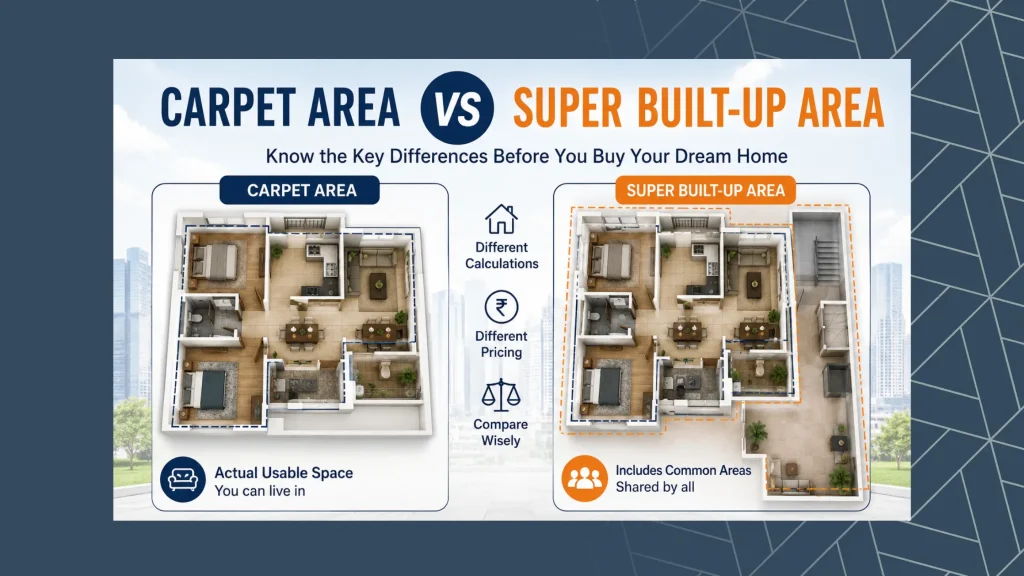
Buying a home is one of the biggest financial decisions most people will ever make. Yet many buyers still get confused by terms like carpet area and built-up area, and super built-up area. These measurements may sound technical, but they directly affect how much usable space you actually receive for your money. Two apartments advertised as 1,500 sq. ft. can feel completely different once you step inside because the actual living area may vary significantly. This is why understanding these concepts is essential before signing any property agreement.
Since the implementation of the Real Estate (Regulation and Development) Act (RERA), developers in India are required to disclose carpet area clearly, bringing much-needed transparency to property transactions. Under RERA, the sale of apartments is intended to be based on carpet area rather than inflated super built-up figures. Experts consistently recommend comparing properties using carpet area because it reflects the real usable living space rather than shared facilities.
Why Understanding Property Area Matters
Many buyers focus only on the property’s advertised size without asking what that number actually represents. Builders often promote larger figures because bigger numbers naturally appear more attractive. Imagine comparing two apartments both marketed as 1,600 sq. ft. One could provide 1,200 sq. ft. of actual living space, while the other may offer only 1,050 sq. ft. The difference exists because each project has a different loading factor.
This misunderstanding can lead to paying lakhs of rupees more for less usable space. Buyers frequently assume that every square foot mentioned in a brochure belongs exclusively to their apartment. In reality, part of that quoted area may represent corridors, lifts, staircases, clubhouses, and other shared amenities. Understanding these measurements helps buyers calculate the real value of a property and compare projects fairly.
Common Mistakes Homebuyers Make
- Comparing flats using only super built-up area.
- Ignoring the carpet area mentioned in RERA documents.
- Believing brochure sizes without verification.
- Not calculating the effective cost per usable square foot.
What is Carpet Area?
Carpet area refers to the actual usable floor area inside your apartment where you can walk, place furniture, and live comfortably. According to the RERA definition, it includes the area covered by internal partition walls but excludes external walls, balconies, verandas, open terraces, and service shafts. Simply put, if you could lay a carpet throughout your home, that space would largely represent the carpet area.
The introduction of a standard RERA definition eliminated confusion that previously allowed developers to use different measurement methods. Before RERA, buyers often had no reliable way to compare apartments because builders emphasized built-up or super built-up areas. Today, carpet area serves as the most transparent measurement for evaluating residential properties.
What is Included?
- Bedrooms
- Living room
- Kitchen
- Bathrooms
- Internal partition walls
What is Excluded?
- External walls
- Balconies
- Verandahs
- Open terraces
- Service shafts
Also Read: Why it is Better to Buy Property in Noida Vs Property in Gurgaon?
What is Super Built-Up Area?
The super built-up area is often called the saleable area. It consists of the carpet area plus the built-up area and a proportional share of common facilities within the building. These shared facilities may include lifts, corridors, staircases, entrance lobbies, clubhouses, gyms, swimming pools, and other common amenities.
Unlike carpet area, super built-up area is not formally defined under RERA. It remains a marketing metric commonly used by developers to represent the total area on which pricing may historically have been calculated. Since every builder allocates common areas differently, the same super built-up figure can translate into very different carpet areas across projects.
Loading Factor Explained
The difference between carpet area and super built-up area is commonly known as the loading factor.
Formula:
Super Built-Up Area = Carpet Area + Share of Common Areas
Many residential projects have loading between 25% and 40%, although premium developments with extensive amenities may have even higher loading.
Carpet Area vs Super Built-Up Area
The easiest way to understand these measurements is through comparison.
| Feature | Carpet Area | Super Built-Up Area |
|---|---|---|
| Actual usable space | Yes | No |
| Includes common areas | No | Yes |
| Includes balconies | No (RERA definition) | Often Yes |
| Used for RERA disclosures | Yes | No |
| Best for comparing properties | Yes | Limited |
| Represents livable area | Yes | No |
Real-Life Example
Suppose a developer advertises an apartment as 1,500 sq. ft. super built-up.
| Component | Area |
|---|---|
| Carpet Area | 1,080 sq. ft. |
| Walls & Balcony | 170 sq. ft. |
| Common Area Share | 250 sq. ft. |
| Total Super Built-Up Area | 1,500 sq. ft. |
Although you pay for 1,500 sq. ft., only 1,080 sq. ft. becomes your actual living space.
Which Area Should You Consider Before Buying?
For most homebuyers, carpet area should always receive greater importance. It tells you exactly how much usable space you will enjoy every day. Whether arranging furniture, planning renovations, or calculating value for money, carpet area provides the clearest picture.
Super built-up area still has relevance because it reflects your share of amenities such as landscaped gardens, clubhouses, gyms, and community spaces. Buyers should evaluate whether these facilities justify the loading percentage. A project with excellent amenities may justify a slightly higher loading, while excessive loading without meaningful benefits could reduce value.
Tips Before Booking a Property
- Always ask for the RERA carpet area.
- Compare cost per carpet square foot.
- Verify project details on the state’s RERA portal.
- Understand the loading percentage.
- Read the sale agreement carefully before signing.
RERA Rules Regarding Carpet Area
Before RERA, developers commonly marketed apartments using super built-up area, making it difficult for buyers to compare projects fairly. The Real Estate (Regulation and Development) Act introduced uniform definitions and improved transparency across the industry.
Under RERA:
- Builders must disclose the carpet area clearly.
- Pricing is intended to be based on carpet area.
- Buyers can compare projects more accurately.
- Misrepresentation may attract penalties.
Several state RERA authorities also include super area only for reference while making it clear that the commercial consideration depends primarily on carpet area and any exclusive balcony area, not on the super area itself.
How to Verify Property Details
Before making any payment:
- Check the project’s registration on your state’s official RERA website.
- Compare brochure specifications with RERA disclosures.
- Confirm the carpet area in the sale agreement.
- Ask for the floor plan showing dimensions.
Conclusion
Understanding the difference between carpet area and super built-up area can save you from costly mistakes. Carpet area represents the actual usable space inside your home, while super built-up area includes your share of common facilities and is generally larger than the space you can actually use.
If you are comparing multiple residential projects, always calculate the price per square foot based on carpet area, not just the advertised super built-up area. This simple habit gives a much clearer picture of value for money and helps you make smarter real estate decisions. Thanks to RERA, today’s buyers have greater transparency than ever before, making it easier to compare properties fairly and confidently.